
Buffalo Nickel Dates: Worn Date Clues and Mint Marks
A practical guide to reading buffalo nickel dates from worn photos: which features reliably narrow the year or mint, and what to do when the digits are unclear.
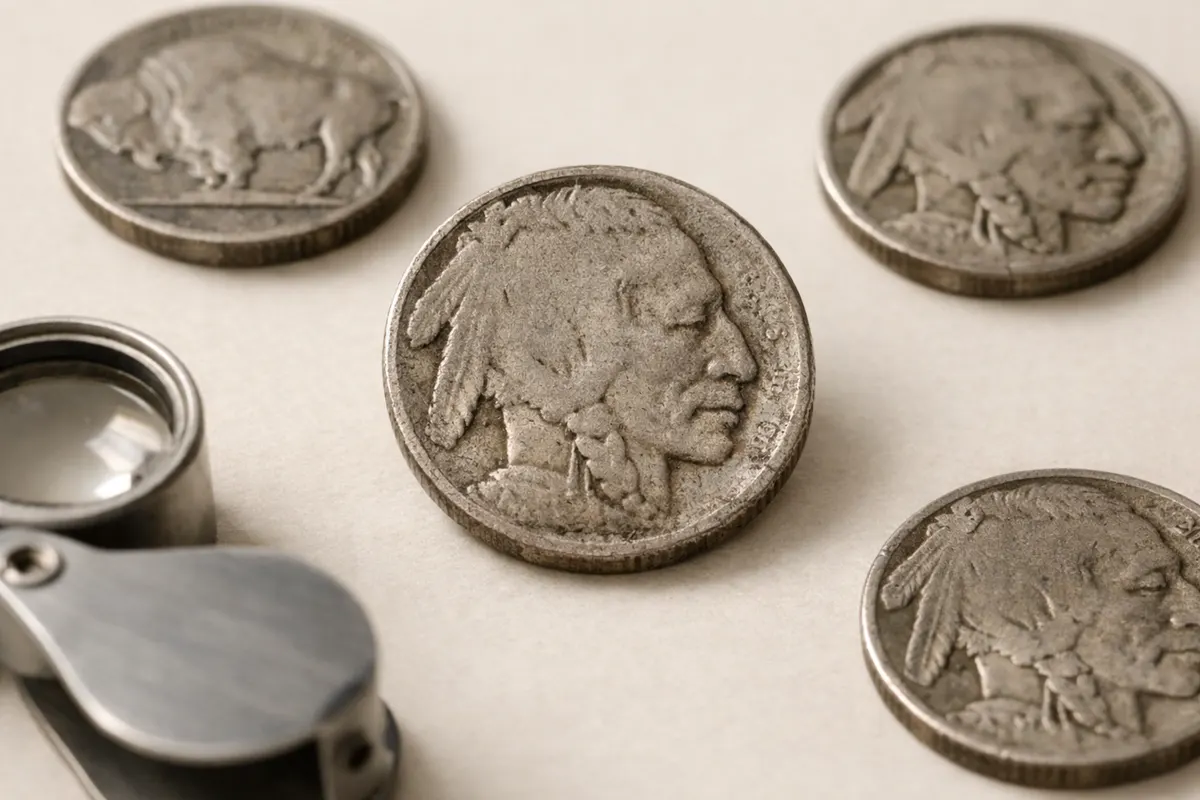
Quick answer: what a worn Buffalo nickel date can actually tell you
When a Buffalo nickel’s date is partially or heavily worn, the most reliable takeaway is not a definitive year but a short list of possibilities you can test. Looking at high points of the digits, the coin’s overall wear pattern, remaining mint marks, and design features often reduces a long list of years to a handful worth comparing in detail.
Start by treating the photograph as an evidence point, not a verdict. A clear photo can show whether the last digit is a 1, 3, 5, 6, 8, or 9, and whether a mint mark exists under the rim. Those two facts together move you from a broad era (1913–1938 for Buffalo nickels) to specific candidate years—especially for known rarity spikes or common-year runs.
In practical terms: buffalo nickel dates in good visible fragments can let you rule out entire decades or confirm a mint mark pairing you should explore. They cannot prove originality of the date or detect subtle alterations, and they don’t replace an in-hand inspection or professional grading when value matters.
If you want a fast checklist: (1) get two obverse shots—straight and slightly angled, (2) inspect the high points of the numerals under shadow, (3) look for mint marks near the rim on the reverse, and (4) note any die breaks or unusual serifs on numbers—those marks often match published example photos for specific years.
- A partial digit often narrows candidates to a small set of years rather than giving a single answer.
- Mint marks (or lack of one) combined with visible numeral fragments are the strongest photo-based clues.
- Wear pattern, die characteristics, and remaining serifs on numbers can point to a specific die variety.
- Photographs alone can’t prove authenticity or market value—treat them as a first-pass identification step.
Which visual clues reliably survive wear and photos
For buffalo nickel dates, prioritize clues that hold up under varied lighting and phone cameras. The most durable details are: (A) the high points of each numeral (the raised edges that wear last), (B) the presence or absence of a mint mark on the reverse, and (C) consistent design wear that matches the coin’s expected circulation life.
High-point edges of numerals often retain tiny serifs or cut-ins even when the center of the digit is gone. For example, the left-hand serif of a worn 3 or the tail of a 7 can survive when the rest of the date is smoothed. Capture both straight-on and low-angle photos: the oblique light reveals residual edges where flat light won’t.
Mint marks on Buffalo nickels are small but critical. Most Philadelphia-struck nickels have no mint mark; Denver and San Francisco marks sit above the rim on the reverse. Even faint traces—dark pits or faint raised remnants—can confirm a mint and rule out entire sets of candidate years.
Die traits and numerals’ style are often stable across a die pairing. Look for small die cracks, a particular curve on the numeral 9, or a shortened serif on the 2. These stable die-level signals let you match a worn date to published photo references or database images when numerals are ambiguous.
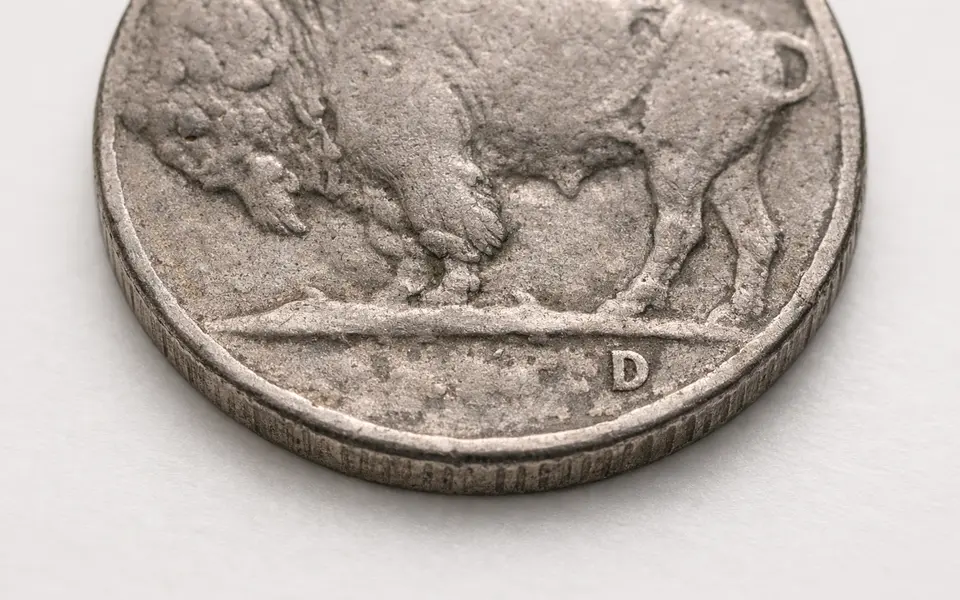
- High-point numeral edges: search for surviving serifs, tails, or cut-ins in oblique lighting.
- Mint mark presence/placement: confirm any mark above the reverse rim (D, S) or its absence for Philadelphia.
- Consistent wear pattern: compare coin’s wear on Indians’ cheek, buffalo shoulder, and date area to assess whether date loss is uniform or likely post-strike damage.
- Die markers: small cracks, extra metal blobs, or matching flaws on the reverse that line up with known die varieties.
Weak signals
Some visual hints look persuasive but frequently mislead on Buffalo nickels. Color or toning, for instance, varies with storage and cleaning and tells you almost nothing about date or mint. Likewise, superficial scratches and corrosion can mimic numeral edges and create false serifs that appear like surviving digits in a photo.
Glare and shallow depth-of-field are notorious for creating phantom strokes. A bright reflection along the rim can cut across a worn numeral and look like part of a 1 or 7; a shallow focus will blur numeral gaps into a continuous stroke that doesn’t represent the true die shape. Always check multiple photos at different angles to reduce these optical traps.
One-angle identification—deciding a year from a single straight-on image—is a weak signal. Poor image scale and unknown tilt make it hard to judge the true thickness and termination of numeral strokes. That’s why comparing low-angle and backlit shots to reveal residual edges is a stronger method than relying on a single shot.
Finally, beware of lookalikes: later-date restrikes, altered dates, or skillful post-strike retouching. A faint gouge can be mistaken for a die feature; conversely, someone may alter a date to resemble a rarer year. Photographs alone rarely expose a careful alteration—physical inspection or multiple high-resolution images from different lighting conditions are safer.
- Toning and color: nearly worthless as a date indicator and often misleading.
- Reflections and glare: can fake numeral strokes—avoid single-shot conclusions.
- Scratches and post-strike marks: can mimic or hide digits; examine from multiple angles.
- Single-photo ID: a fragile basis for a year, especially when the date area is worn.
How to compare candidate years and mint marks step by step
Comparison is where a photograph becomes useful: rather than guessing a year outright, put the coin next to candidate-reference images and check a short list of matching criteria. Start by listing candidate last digits you can still read or suspect—e.g., the last digit looks like a looped 3 or a straight 1—then pair each candidate with known mint marks that fit the coin’s reverse evidence.
Next, compare die traits. Use two reference photos per candidate year: one of a common die and one of a known variety. Look for matching die cracks, the angle and serif of numerals, and the relative spacing between digits and the rim. If two or three attributes match the reference for a single year and mint, that candidate moves up your confidence scale.
Keep a simple scoring method: +2 for a mint-mark match, +2 for a surviving numeral serif that matches reference, +1 for matching die crack or blob, and -1 for conflicting wear direction or obviously altered features. This makes the result more transparent than a gut impression and helps you prioritize candidates for further research.
A practical example: if the visible fragment shows what may be a 5 tail and a faint S near the reverse rim, compare San Francisco 1935, 1936, and 1937 references. If the numeral tail and a particular die crack on the reverse line up only with 1936-S references, that year becomes your primary candidate for in-person verification.
- Assemble 2–4 candidate years from visible digits and mint mark traces.
- Pull up reference images for each candidate year and look for die cracks and numeral serifs.
- Score matches with an objective checklist (+2 mint mark, +2 numeral serif, +1 die marker).
- If the coin scores similarly across multiple years, prioritize in-hand inspection or expert review.
App workflow
After you’ve run the visual checklist, use an app like Coin Identifier - Coinora as a methodical second pass, not a final appraisal. The app is most helpful when you already know a few candidate years or suspect a mint mark; feeding those options into the tool speeds up matching and highlights close visual references you might miss on a first scan.
When you run a search in the app, treat the top matches as research leads. Compare the app’s suggested photos to your own images and the scoring checklist you used earlier. If the app suggests the same year and mint you already favored from visible clues, your confidence increases; if it lists different years, re-check the numeral serifs and reverse mint-mark area for missed details.
Use the app output as a way to collect references and annotate specific matching features—note where a die hairline matches the reverse or where the numeral tail aligns. Keep the app’s results as research notes: they narrow possibilities but don’t certify authenticity or market value.
For broader photo-taking advice and how to frame coin images to improve both visual checks and app matches, see Coin Detection: Visual Clues, Similar Lookalikes, and Safe Next Steps at https://coin-identifier.app/blog/coin-detection. That guide complements this checklist with more examples of how lighting and angles reveal different clues.
- Use the app as a second-pass research tool after you’ve gathered visible clues.
- Treat app matches as leads to confirm, not final identification or value statements.
- Compare the app’s suggested references with your scored checklist to increase confidence.
- Keep a record of app results and photo evidence to show to experts or in forums for in-hand follow-up.
Related guides
Run your photo checklist, then check Coin Identifier - Coinora
After you’ve checked numeral edges, mint-mark traces, and die markers, use Coin Identifier - Coinora to compare your best photos against curated reference images. Treat the app’s matches as research leads—they help prioritize which candidate years and mint marks to inspect further. If your results remain unclear, keep the app’s notes and show them with high-quality photos or the coin itself to an expert for an in-person check.
Take the next step →Frequently asked questions
When a Buffalo nickel date is half-worn, what do buffalo nickel dates meanings suggest for identification?
If a date is only partly visible, buffalo nickel dates meanings focus on what fragments can reliably indicate: surviving serifs, the shape of numeral ends, and mint-mark traces. Those elements typically tell you which digit family the worn numeral belongs to (for example, a curled tail suggesting a 3 or 5) and whether the coin likely came from Philadelphia, Denver, or San Francisco. Use those clues to compile candidate years rather than assuming an exact year; the meaning of each surviving stroke is probabilistic and must be cross-checked with die references and mint-mark evidence.
How do I tell if a faint mark near the rim is a mint mark or just damage?
Mint marks on Buffalo nickels are small and sit above the reverse rim; damage often has irregular edges or follows a scratch-like pattern. To test a faint mark, photograph the reverse at low-angle light and from straight-on. A mint mark will usually show as a rounded, raised form with a consistent outline and may cast a tiny shadow when lit from the side. Damage tends to be flaky, pitted, or linear. Compare the suspect area to reference photos for D or S mint marks from the candidate years to see if the shape matches known mint-mark forms.
What are good buffalo nickel dates examples I can use when comparing my worn coin?
Start with common, well-photographed examples from the 1920s–1930s that show typical wear patterns and die variants. Look for photos that highlight numeral serifs, mint marks, and die cracks for years you suspect—those are the most useful buffalo nickel dates examples for matching. When possible, pick one high-quality reference of a commonly circulated die and one of a lesser-known variety; comparing both helps you spot matching die markers even if the date itself is heavily worn.
If an app suggests a rare year but my photos are inconclusive, what should I do next?
Treat an app suggestion of a rare year as a prompt to gather stronger evidence rather than proof. Take more photos at different angles and with oblique side lighting, check for mint-mark traces on the reverse, and compare die markers in reference images. If uncertainty remains, document your photos and findings, and seek an in-hand inspection from a trusted local dealer or certified grader. Avoid listing the coin as a confirmed rare date based solely on an app match or a single photo.