
Lincoln Penny Errors: Doubled Dies, Mint Marks, and Date Clues
Learn which visible details actually reveal lincoln penny errors, how to photograph and compare them, and the safe next steps before trusting one image.
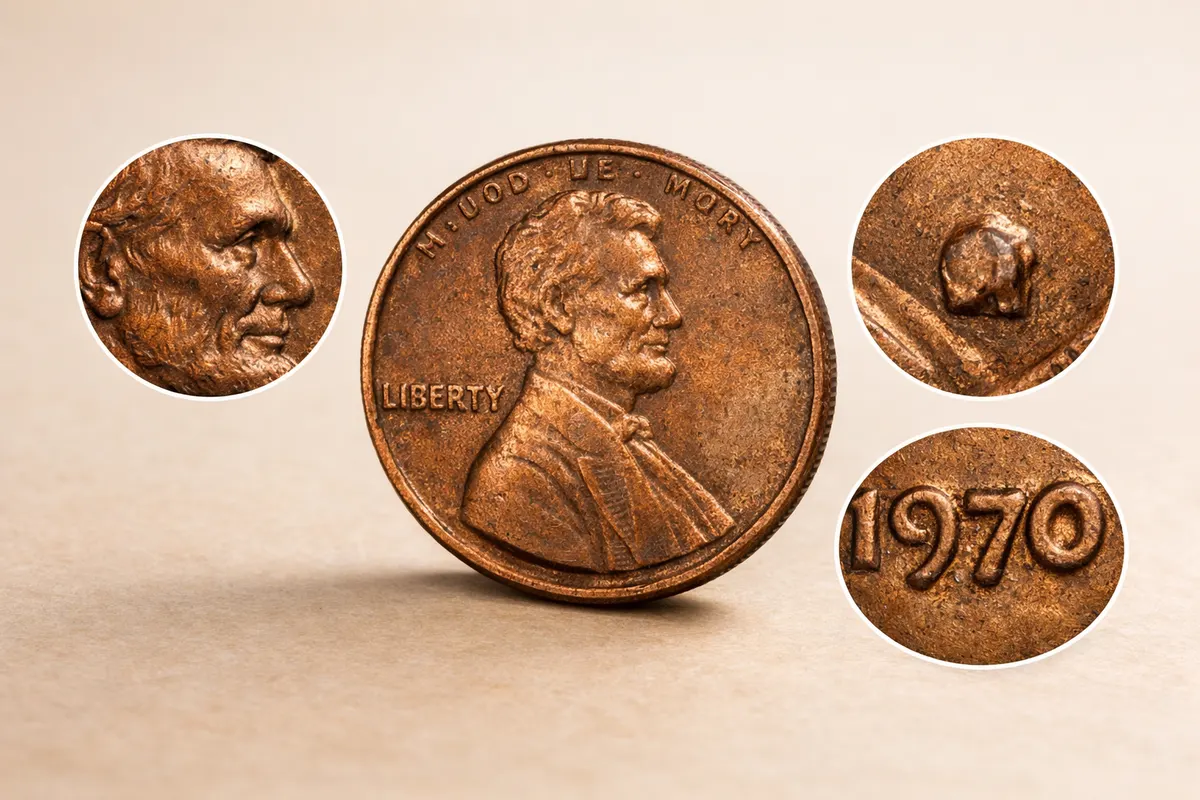
Quick answer: reading Lincoln penny errors
When you look for lincoln penny errors in a photo, the clearest signals are shape-based: doubled letters and numbers, misaligned mint marks, die chips or cuds that create raised blobs, and clear repunched details where metal shows overlapping impressions. These traits are geometric and persist under different lighting or angles if the photo is sharp enough.
A single photo can often show whether a doubled die exists (noticeable twin outlines on date digits or lettering) or whether a mint mark was repunched (a ghosted second mark beside the primary one). However, a single image rarely proves authenticity, exact variety, or market value. Wear, cleaning, and post-strike damage can mimic error features.
Treat visible clues as diagnostic leads: they narrow the list of likely explanations and point you to reference varieties and specialist forums. Photograph both sides, capture the date and mint mark close-up, and note the coin’s color and weight separately—those contextual details help a second look but do not replace a careful variety comparison.
- Most useful photo clues: doubled lettering/dates, repunched mint marks (RPM), die chips/cuds, and aligned die breaks.
- Single-photo limit: cannot confirm die state, provenance, or market value on its own.
- Next step after spotting a clue: take controlled close-ups, compare to reference die-variety photos, and log uncertain findings as research notes.
Strongest visual clues on Lincoln pennies
For lincoln penny errors, prioritize clues that are about edge-to-edge geometry and relief rather than surface color. Doubled dies show as two distinct impressions separated by a measurable gap: look at the date, the letters in 'LIBERTY', and 'IN GOD WE TRUST' for repeated strokes or doubled serifs. These doubled lines are raised and cast consistent shadows when the light angle changes.
Repunched mint marks and RPMs are also robust clues. An RPM appears when a mintmark punch was struck more than once in slightly different positions; the overlap is visible as a faint second letter or as part of the mintmark showing displaced serifs. RPMs are most obvious on close-up photos taken perpendicular to the coin surface with even lighting.
Die chips, cuds, and die cracks provide locality clues: raised lumps (die chips) or a missing rim segment (a cud) indicate the die broke in a certain place. These features are usually the same for every strike from that die until it’s retired, so matching those features to reference images is strong evidence of a common die variety.
Raised doubling differs from post-strike damage. Doubling from the die (a doubled die) is part of the struck design and appears integrated with surrounding fields; damage and tooling sit on top of the strike and have irregular edges. When in doubt, tilt the coin or compare shadows: die-origin doubling keeps consistent shadow behavior with the strike; surface marks catch light differently.
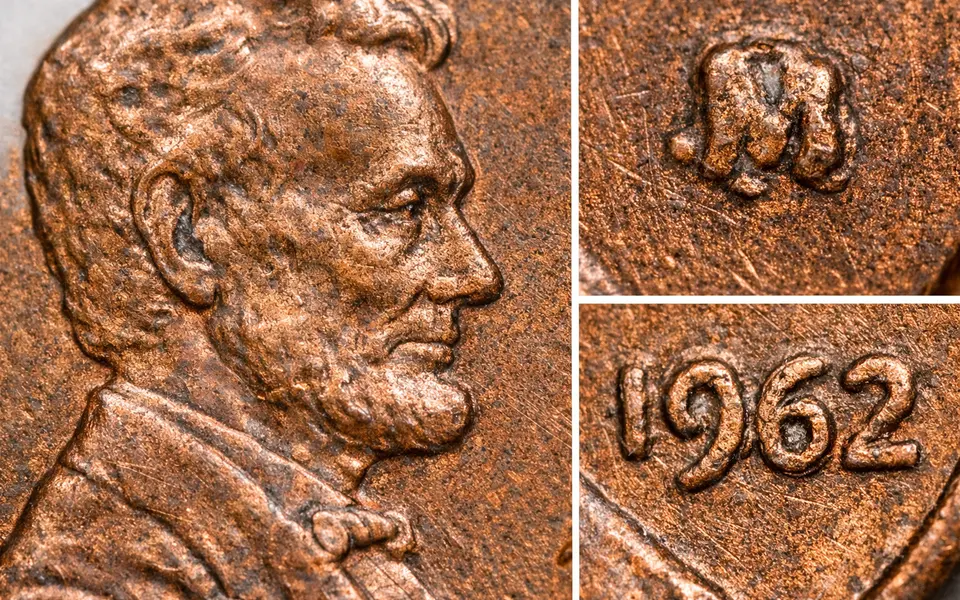
- Doubled die: look for repeated stroke outlines on numerals and letters that remain visible across light angles.
- Repunched mint mark (RPM): faint second letter beside the main mint mark, often visible in perpendicular close-ups.
- Die chips/cuds/cracks: raised lumps or missing rim sections that match reference images.
- Raised features integrate with surrounding design—post-strike damage usually sits on top and looks inconsistent.
Weak signals
Color and tone—red, brown, or red-brown—are weak signals for error identification. Copper coloration tells you about surface chemistry and storage, not die state. Two pennies can look different in color because of circulation or cleaning while sharing the exact same die variety. Avoid using color as primary proof of an error.
Glare, focus blur, and oblique angles create ghosting that looks like doubling. Photographing at a low angle often exaggerates relief and produces reflected highlights that mimic doubled strokes. Relying on a single oblique shot can mislead you into calling a doubling that is actually a lighting artifact.
Worn or polished digits can create appear-to-be doubled edges. Loss of metal or rim wear can make numerals look thickened or split. Similarly, post-strike damage—nicks, planchet flaws, and die polishing lines—can be mistaken for die doubling when the image lacks resolution.
Generic wear patterns and common circulation marks are not diagnostic. If the only unusual trait is an odd scratch or rim ding, it is probably post-strike. Reserve error claims for features that repeat across multiple letters or strikes or that match a known die variety illustration.
- Do not treat color or patina as error proof—use it only for context.
- Avoid calling doubling from single-angle or blurred photos; re-shoot with perpendicular lighting.
- Polishing, cleaning, and wear can mimic doubling—document evidence of surface treatment.
- Minor scratches, corrosion, and planchet laminations are weak signals unless they match a die-specific pattern.
A practical comparison workflow for Lincoln penny errors
Follow a step-by-step comparison workflow to turn a visible clue into a useful identification: 1) photograph and document, 2) isolate the diagnostic area, and 3) compare to reliable references. Start by photographing the obverse and reverse in even light, then take focused close-ups of the date, mint mark, and any doubled lettering or die chips.
When isolating the diagnostic area, crop tightly to the feature and inspect pixel-for-pixel if you can. For a suspected doubled die, focus on one letter or digit and check for parallel duplicate lines, doubled serifs, or offset stroke termini. If the doubling repeats across multiple characters (for example both the date and part of 'LIBERTY'), the case for a doubled die becomes stronger.
Next, compare your cropped image to authoritative photos: die-variety guides, auction archives, and high-resolution reference collections. Use three checks: matching location (does the doubled stroke appear in the same spot on the coin?), matching shape (is the offset identical in angle and curvature?), and matching size (do the doubled elements have the same proportions?). A match on all three is a credible identification lead.
Keep a log of what you find: date, mint mark, wear grade approximation, visible doubling description, and a note on photo quality. If your comparison narrows the coin to a small set of candidate varieties, those become the terms you search in specialist forums or reference catalogs. When you still have uncertainty, treat that result as a research note and seek a second opinion that uses the same cropped evidence.
- Photo checklist: full obverse/reverse, perpendicular close-ups of date/mint mark, and an angled shot for relief checks.
- Isolation checks: pixel-level crop of suspected doubling, examine repeated strokes across letters/digits.
- Three-match comparison: location on the design, shape of the doubled element, and proportional size.
- Record findings: date, mint mark, brief doubling description, and photo quality notes before reaching out for help.
Using the app after you check Lincoln penny errors
After you gather photographic evidence and compare the strongest clues, an app can be a helpful next pass. Use Coin Identifier - Coinora on your device to quickly index the coin and surface possible varieties based on your noted clues—date, mint mark, and visible doubling. Consider the app’s suggestion as a prioritized list of leads rather than a final verdict.
Prepare images for the app by following the same photographic checklist: even diffuse lighting, perpendicular close-ups of the date and mint mark, and a secondary angled shot to confirm relief behavior. Because the service does not replace specialist authentication, treat the app result as a triage tool that suggests which reference images or forums to consult next.
If the app suggests a match, take those reference names and compare them to high-quality photos in dealer archives, numismatic books, or dedicated die-variety databases. Use the app’s result to refine search terms—for example, adding a suspected doubled-die year and 'obverse' or 'repunched mint mark' will return more targeted comparisons.
Keep research notes for each candidate: where the app suggested the match, what photographic evidence supports it, and which features you still can’t confirm. If the coin appears to be an uncommon variety, consider sending high-resolution scans or seeking an on-site specialist who can inspect weight, strike characteristics, and die markers in person.
- Use the app to generate candidate varieties after you document visible clues.
- Treat app results as leads; verify matches with high-res reference photos and specialist sources.
- Prepare images with perpendicular close-ups plus an angled relief shot for the app.
- Log app suggestions alongside your own photo evidence and note any unresolved questions.
Related guides
Check your clues with Coin Identifier - Coinora
After you document clear clues—close-ups of the date, mint mark, and any doubled lettering—use Coin Identifier - Coinora on your device to get candidate matches. Treat the app’s results as research leads: compare suggested varieties to reference photos, log what you can’t confirm, and seek a specialist when the coin seems uncommon. The app is a fast next step after your photo checklist, not a final certification.
Take the next step →Frequently asked questions
How can I tell a doubled die from a damaged coin in photos?
Doubled dies create repeated, parallel impressions that align with the design: look for duplicate serifs or twin strokes on letters and numerals that keep the same spacing across angles. Damage or tooling sits on top of the strike and has irregular edges, inconsistent shadowing, or scratches that do not replicate across multiple characters. To be sure, crop a perpendicular close-up of the suspect letter and check whether the doubled outline matches reference images for that year.
Are mint mark overlaps and repunched mint marks the same thing?
They are related but distinct. A repunched mint mark (RPM) happens when the mint punch was struck more than once in different positions, leaving a ghosted second mark beside the main one. Overlap or doubling of the mint mark can sometimes look like a doubled die, but RPMs are usually constrained to the mintmark area and show displaced serifs or partial letters. Close-up photos at perpendicular angles make RPMs clearer than oblique shots.
Can color, shine, or toning confirm a Lincoln penny error?
No. Color, shine, and toning reflect surface chemistry, storage conditions, and treatment—not die state. While some error coins may develop distinctive patinas, those surface attributes are secondary context only. Rely on shape-based clues—doubling, die chips, cuds, and RPMs—rather than color when identifying errors.
What should I do if I think I have a rare Lincoln penny error but aren’t certain?
Document everything: take perpendicular close-ups, an angled relief shot, and full obverse/reverse photos; note weight and any storage history you know. Use reference images to narrow possibilities, log candidate varieties, and treat any uncertain identification as a research note. After that, use a triage tool like Coin Identifier - Coinora to gather candidate names, then seek a second opinion from a die-variety specialist or trusted grading service if the coin appears uncommon. Avoid making value claims until multiple experts agree.