
How to Check Coin Values: A Practical Photo-First Checklist
Learn what a photo can reveal when you check coin values, which checks need tools or experts, and practical next steps to verify a coin's worth.
Quick answer for check coin values
A clear photograph is the fastest way to begin to check coin values, but it rarely gives a full answer on its own. From a photo you can usually confirm the coin’s date, mint mark (when present and readable), major design type, visible damage, and whether the surface shows signs of cleaning or major alteration. These clues are often enough to narrow the coin to a likely type and condition range for further research.
Photos cannot prove metal content, exact weight, or the coin’s authenticity. Surface appearance can be altered by plating, polishing, or environmental deposits; none of those are reliably detectable from a single image. Similarly, a photo cannot show internal layering or metallurgical inconsistencies that would require appropriate professional, non-destructive examination to detect.
If your goal is to check coin values, use photos as a first-pass filter: identify the coin type and condition band, note anything that reduces trust (heavy wear, holes, severe cleaning), and then follow up with simple physical checks or a trusted third-party opinion. Treat the photo as an evidence piece that points to the next steps rather than a final appraisal.
Use a photo-identification suggestion to narrow the issue, then research verified completed sales for that issue and a comparable condition. The Coinora photo identifier (https://coin-identifier.app/tools/free-coin-identifier) is an initial identification aid. A match is not a certified grade, authentication, or appraisal.
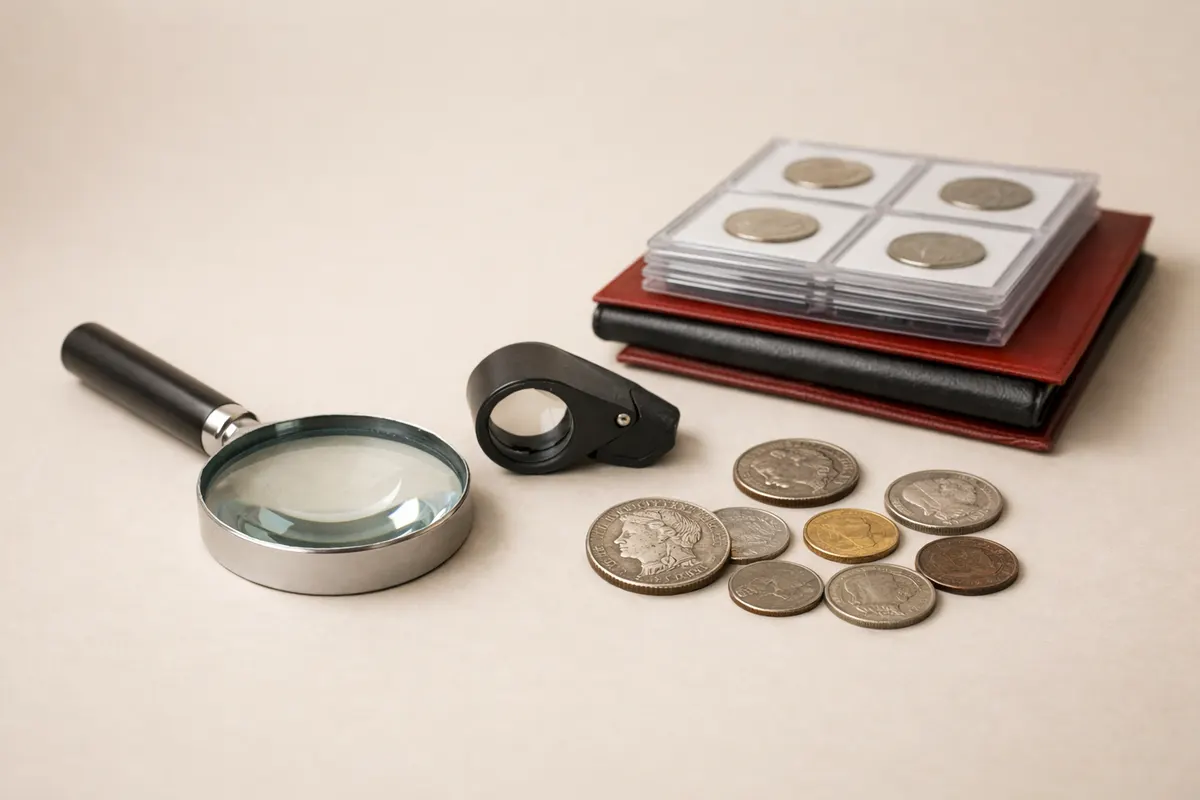
AI-generated illustration. The pictured coins are not authenticated specimens or price comparables.
- Photo can confirm: date, mint mark (if readable), design type, major wear, obvious damage or cleaning.
- Photo cannot confirm: metal composition, exact weight, authenticity, or provenance.
- Use photos to decide next steps: measurements, non-destructive screening, or expert verification.
What 'check coin values' actually involves
When people say they want to check coin values they typically mean one of three different things: identify the coin type (who, what, when), determine whether it’s bullion metal or a collectible, and estimate the market interest or collectible premium. These are related but separate questions. Identification often comes from visual cues; bullion content or melt value depends on composition and weight; collectible premium depends on date, mint mark, condition, and market demand.
Identification is the baseline: once you know the coin’s type and date range you can consult price guides or recent sales for similar-condition examples. Determining whether the coin carries a “collectible premium” requires careful attention to date and mint mark differences (for example, some Morgan dollar dates and mint marks are substantially more desirable than others) and to the coin’s surface condition or grading traits.
Collectors and dealers treat the coin’s denomination as a label, not as a value floor. Denomination tells you what the coin was originally worth by face value, but for most collectible U.S. coins—like Morgan dollars—the market value depends on silver content, scarcity by date/mint/condition, and collector demand. Use identification plus condition notes to decide whether to pursue weight/composition screening and professional verification.
- Identification → date and mint mark guide what to research next.
- Composition affects bullion content; weight and magnetism only screen for inconsistencies, while suitable professional analysis is needed to assess alloy.
- Collectible premium → determined by date/mint mark and condition, not denomination alone.
Key photo clues to check coin values quickly
When you set out to check coin values from photos, prioritize consistent, well-lit images of both obverse and reverse plus the coin’s edge. The following visual clues are the highest-yield observations for narrowing possibilities and spotting red flags that affect value or authenticity risk.
Good photographs serve two purposes: they let you read diagnostic marks (dates, mint marks, designer initials, privy marks) and they record surface texture that helps separate original mint fields from later alteration. Always keep a written note of the camera settings and scale object you used; that context helps later comparisons.
Below are the specific visual clues to record and how they influence the next step in a values check.
- Readable date and mint mark: anchors research to a specific issue and known rarity patterns.
- Design details and die markers: doubled dies, repunched mint marks, or known die varieties change interest.
- Wear pattern and devices: high-point wear vs polished fields affects collectible premium.
- Surface condition: hairlines, abrasions, and luster changes indicate cleaning or circulation.
- Edge features: reeding, plain edges, or interruptions can reveal circulation strikes or later edge alteration.
- Color and toning: original toning can be positive for collectors; uneven or scraped color may signal cleaning.
- Obvious damage: holes, rim nicks, deep scratches, or corrosion often reduce value substantially.
Step-by-step workflow to check coin values from photos
Work through a consistent checklist so you don’t skip steps that matter. Start with the simplest, non-destructive evidence and escalate only as needed: photos → measurements and screens → reference research → expert or lab verification. Document everything and avoid cleaning, bending, or aggressive polishing at any stage.
1) Photograph thoroughly: take high-resolution images of the obverse, reverse, and the full edge. Use neutral lighting and include a ruler or coin-size reference. Capture at least two angles to show reflective luster and any toning.
2) Identify the coin type: note the date, mint mark, and design. Use reputable references or the Coin Identifier tool to confirm the issue. A correct ID narrows the pool of comparable sales and known problem issues (for example, common counterfeit patterns or known die varieties).
3) Screen with weight/diameter/magnetism: weigh the coin on a calibrated scale and measure its diameter and thickness with calipers. Test magnetism with a small magnet. Treat these observations as screens: mismatching specs can raise a serious authenticity concern, but matching specs do not prove composition or authenticity by themselves.
4) Compare conditionally similar examples: look for images of well-documented, similarly dated and marked coins in similar condition. Use auction archives and recent sold listings rather than active listings to see what buyers actually paid.
5) Escalate when needed: if the coin’s type or composition is uncertain, seek non-destructive laboratory screening or a professional grader. For suspected plating or alteration, advanced tests (XRF or specific gravity performed by a knowledgeable lab) can help, but remember XRF is surface-sensitive and may not reflect core composition on plated or heavily treated coins.
6) Preserve a chain of evidence: store the coin in an inert holder, retain the original photos and measurement notes, and avoid handling that could change surface condition prior to any professional review.
- Photograph both sides and the edge with a scale reference.
- Identify date and mint mark before doing any measurements.
- Use weight/diameter/magnetism as screening tools only—never conclusive.
- Compare to sold auction records and quality-graded photos, not just listings.
- If anything is suspicious, stop and consult a trusted lab or third-party grader.
Practical examples of checking coin values with photos
Example A — Worn common date coin: A clearly worn Morgan-type silver dollar with an obvious date and mint mark can usually be identified from photos. For a heavily circulated specimen, photos may suggest the type and a broad condition range, without certifying a grade, which tells you whether the coin is likely sought by date/mint specialists. Compare documented sales for the same date, mint, and comparable condition. If authenticity or metal content affects the decision, obtain suitable professional examination even when the photograph looks convincing.
Example B — Apparent shiny restored surface: Photographs that show bright, reflective fields with fine fine-line hairlines often indicate past cleaning or mechanical polishing. Cleaning reduces collector interest. Use photos to document the problem and to choose the right escalation: do not polish further; instead, keep the coin in its current state and seek a second opinion from a reputable grader if the date/mint make the piece potentially valuable.
Example C — Suspected non-legal tender or altered piece: If photos show inconsistent edge treatment, odd reeding, or an imprecise strike, that’s a signal to run weight and diameter checks. If those measurements are outside the known specification range for the identified issue, the coin may be a counterfeit or heavily altered. Remember, even matching dimensions do not exclude plated cores or layered fakes—those require lab screening for confirmation.
Where Morgan dollars are used as an explanatory example, readers should consult published specifications. The Professional Coin Grading Service documents the Morgan dollar composition and dimensions, which are important benchmarks when you check coin values: PCGS Morgan Dollar Facts and Specifications (https://www.pcgs.com/coinfacts/coin//7276). Use those specs for initial screening only; they are not a substitute for professional testing when authenticity is in doubt.
- Worn common-date coin: photos determine type and condition band for price research.
- Shiny/restored surfaces: visible hairlines and sheen changes point to cleaning.
- Edge or reeding irregularities: photograph and measure, then escalate if out of spec.
Limitations
A single photo or a set of photos is valuable but limited. Photographs can show surface traits and help identify a coin’s type and condition band, but they cannot prove metal composition or confirm authenticity on their own. For example, weight, diameter, and magnetism are useful screening observations; mismatches should prompt concern, but matches do not prove the alloy is original or that the coin is genuine.
The specific case of Morgan dollars illustrates the distinction between denomination, bullion content, and collectible premium. Morgan dollars are denominated as one-dollar coins and contain silver per the mint’s original specifications; these specifications (metal, weight, diameter) are documented by references such as the Professional Coin Grading Service. Use those specifications to screen a candidate coin, but do not treat matching dimensions or a non-magnetic response as proof that the coin is genuine or that its silver content is intact.
Do not assume a coin that looks right in photos is untampered. Common deceptive treatments include plating a cheaper core with a thin silver or silver-like outer layer and mechanical or chemical cleaning to mimic high grade. X-ray fluorescence (XRF) testing can detect surface composition but is surface-sensitive, meaning it may read the plating or surface layer rather than the coin’s core if plating is present. For that reason, XRF results should be interpreted by a knowledgeable technician and combined with other evidence rather than relied on alone.
When value or authenticity matters, preserve the coin and consult a qualified dealer, grader, or laboratory. Keep the original photographs and measurement notes yourself. The Coinora photo identifier (https://coin-identifier.app/tools/free-coin-identifier) can suggest an identification to research, but it does not replace an in-person examination or certified appraisal.
- Photos + measurements are screening steps, not proof of composition or authenticity.
- Dimension matches do not rule out plated cores or other alterations.
- XRF is surface-sensitive—interpret results with expert guidance.
- When stakes are high, preserve the coin and consult a trusted lab or grader.
Related guides
Identify the issue before comparing sold prices
Try the Coinora photo identifier (https://coin-identifier.app/tools/free-coin-identifier) for an initial suggestion, then verify the date, mint mark, and design against a trusted reference. Compare relevant completed sales and seek professional authentication or grading when it affects the value.
Take the next step →Frequently asked questions
Can I check coin values accurately using only photos?
Photos let you identify the coin’s type, read date and mint mark when visible, and judge surface condition—information that narrows value ranges. However, photos cannot prove metal composition, confirm authenticity, or replace measured weight and laboratory analysis. Use photos for initial screening and to decide whether to run measurements or seek professional verification.
How do weight and diameter tests help when you check coin values?
Weight and diameter checks are quick screens that detect gross mismatches against the coin’s known specifications. A large deviation is a red flag for a counterfeit or an altered piece. But matching weight and diameter alone do not prove the coin’s alloy or authenticity, because plated or layered fakes can mimic those measurements. Treat these tests as useful but limited evidence.
Is XRF testing definitive for metal composition?
XRF can identify surface composition and is a helpful, non-destructive tool, but it is surface-sensitive. If a coin has been plated or chemically treated, an XRF readout may reflect the outer layer rather than the core. Use XRF results in combination with weight/diameter checks, visual inspection, and provenance; when in doubt, consult a metallurgist or a lab that can perform complementary tests.
What should I do if a photo suggests my coin might be valuable?
Preserve the coin in an inert holder and stop any cleaning or handling that could alter the surface. Collect clear photos of both sides and the edge, record weight and diameter, and note provenance. Research comparable sold examples for the same date, mint mark, and condition band. If the coin’s type or condition suggests significant value, contact a reputable third-party grading service or a trusted dealer for a hands-on appraisal rather than relying on online listings alone.