
Coin Checker Value: What a Photo Can — and Can't — Prove
Learn what a coin checker value can reliably show from a photo, which clues need measurements or tests, and the quick follow-ups before you act.
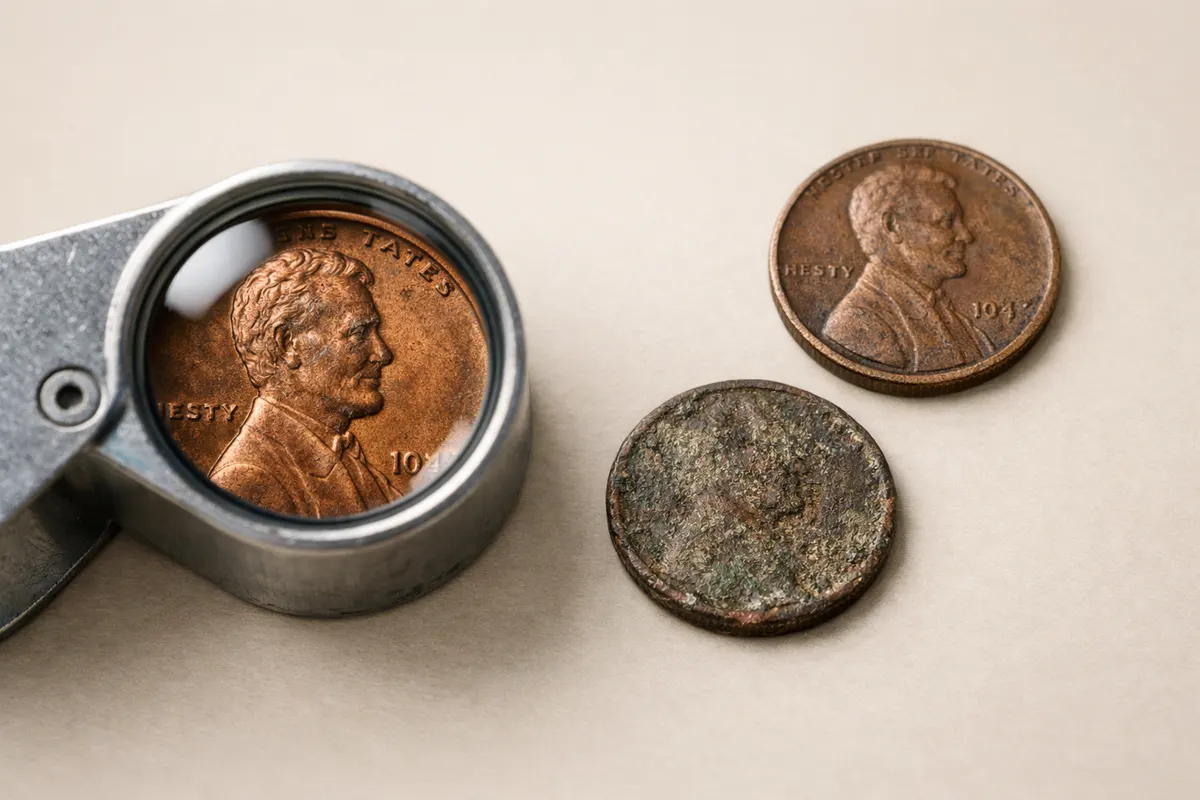
Quick answer: what coin checker value can show from photos
A coin checker value based on a photo can quickly identify obvious traits that influence price: the visible date and mint mark, major design type, signs of extreme rarity like an unusual error, and general wear grade. For many common modern coins or circulated older coins, a good photograph plus a measured weight and diameter will let you narrow value to a broad range (for example: common circulated vs collectible grade).
A single photo cannot prove fine details that shift value dramatically. Photos rarely confirm metal composition exactly, subtle cleaning or surface alteration, or an exact certified grade. Use images as a fast, evidence-driven first pass: gather clear photos of both faces and the edge, take weight and diameter readings, and then treat any on-screen estimate as provisional until you verify with measurements or a market check.
Practical example: a clear, two-sided photo of a 1943 steel penny with a visible mint mark and edge color can strongly suggest steel composition and guide you toward a narrow set of identification outcomes. But to move from identification to a reliable value, you still need weight, a magnet check, and a look at provenance or recent sold listings.
- Photo can reliably show: date, mint mark, major design type, surface wear, die errors visible at normal resolution.
- Photo cannot reliably show: exact metal content, micro-scratches from cleaning, internal corrosion, or certifiable grade.
- Best immediate action: photograph both sides and the edge, put a ruler or coin for scale, and record weight & diameter before trusting a single-image value.
What coin checker value means for your coin
When people ask about “coin checker value,” they usually want an estimate of how much a specific coin could sell for in the current market. A photo-based coin checker gives a visual appraisal: it ties visible characteristics to likely market categories (for example, “common circulated,” “collector interest,” or “possible error/variety”). That estimate is an informed starting point, not a binding appraisal.
A photo-supported estimate blends three things: observable condition, identifiable type/variety, and visible indicators of authenticity or alteration. Observing a date and mint mark tells you which production run to compare; wear and surface condition lets you pick a rough grade band; and unique marks or errors might push the coin into a rarer category. Each of these inputs affects value, but not all are fully verifiable from pictures alone.
Because “value” depends on both the coin’s physical features and current demand, a coin checker value is best read as directional. It guides what follow-up checks will matter most — for instance, where a confirmed weight or a magnet test will collapse uncertainty, or when a suspected die variety deserves a specialist’s eye.
- Value is directional: a photo helps sort coins into likely market tiers rather than precise dollar amounts.
- Visible traits map you to comparable market listings; unseen traits require measurement or third-party verification.
- Use the photo estimate to prioritize next steps: measure, test, compare sold listings, or consult a professional.
Key visual and contextual clues for coin checker value
Start with these visible clues when using a coin checker to estimate value. Photograph both sides (obverse and reverse) and the edge in sharp, even light. A clear date and mint mark immediately narrow the set of comparable coins. Patterns of wear — for example, whether high points like a portrait’s cheek are smooth or still show luster — indicate broad grade bands (Good, Fine, Extremely Fine, etc.).
Design anomalies matter: large die cracks, doubled dies, off-center strikes, or overstrikes can elevate value if they are genuine. Look for consistent, repeatable features across the design or inconsistencies that suggest damage. Surface texture and color give clues about metal: silver and base-metal coins show different toning, while copper alloys patinate versus corrode differently.
Contextual clues that a photo can provide include the coin’s holder (slabbed vs raw), any handwritten notes with provenance, and the presence of a lot or vendor sticker. These don’t prove value, but they help prioritize verification steps — for instance, a coin seen in a reputable auction lot with a matching photo is easier to price than an unproven, single-image listing.
- Date and mint mark: narrows production year and mint run.
- Overall wear: shows likely grade band (circulated vs uncirculated).
- Die varieties/errors: doubled dies, misstrikes, and major die breaks are strong value drivers if verified.
- Edge detail: reeding, lettering, or smooth edge can identify type and detect alterations.
- Color and toning: suggest metal type and possible cleaning or corrosion.
- Holder/provenance marks: auction tags or certified slabs increase confidence in value signals.
Step-by-step workflow to check coin checker value from photos
1) Photograph and document. Lay the coin flat on a neutral, matte background and photograph both sides and the edge. Include a ruler or a common coin for scale and use diffused light to avoid glare. Take one close crop to show the date/mint mark, one wider shot showing the whole coin, and one angled shot of the edge. Record the coin’s date, mint mark visible position, and any obvious errors in a text note immediately.
2) Measure weight and diameter. A clear photo narrows type, but weight and diameter are decisive for composition and variant checks. Use a digital scale (0.01 g resolution if possible) and calipers. If a coin’s photo suggests it might be a silver or steel variant, a magnet test or simple density check can help confirm what your eye sees in the image.
3) Compare to known specs and market comps. Use the visible type and measurements to find exact specifications (mintage, metal composition, common variants) and then search recent sold listings for the same date, mint mark, and apparent grade. Focus on sold prices rather than asking prices. The photo helps you choose the correct comparables — for example, distinguishing 1909-1910 Lincoln cents with VDB from other years.
4) Screen for alterations and fraud. Look closely in your photos for tool marks, unnatural polish lines, re-surfacing, or inconsistent edges that suggest plating or trimming. If the coin is slabbed in a certified holder visible in your photo, note the certification number and provider, and verify it on the certifier’s database.
5) Decide next steps. For low- to mid-value coins, the photo-plus-measurements route and market comps often provide a reliable estimate. For suspected high-value coins, rare die varieties, or any signs of alteration, get a second opinion from a trusted dealer, auction house, or third-party grading service before making decisions.
- Photograph: obverse, reverse, edge, and a scale reference.
- Measure: weight (digital scale) and diameter (calipers) — record both.
- Check composition: magnet test and compare density where needed.
- Market scan: prioritize sold listings with matching date/mint/grade.
- Verify holders: confirm slab numbers with certifier databases.
- Escalate when in doubt: specialist opinion for rare or high-value finds.
Examples: how photos shape a coin checker value
Example 1 — A worn 1943 Lincoln cent: A clear photo showing a grayish, magnetic surface and a visible 1943 date strongly suggests a steel cent rather than the usual bronze. In a photo-led check, you’d note the magnet test and weight as immediate next steps. If both confirm steel, the coin's value will be set by condition and any mint mark; the photo helps you decide whether it is worth a specialist look or a routine market comparison. (See a dedicated example in our 1943 steel penny guide for more on visual cues.)
Example 2 — A Morgan dollar with an odd die crack: A high-resolution photo showing a bold crack across the eagle’s breast may indicate a collectible die break. Photos help determine if the feature looks like a genuine die error (consistent steel flow, matching marks on multiple coins from the same die) or post-strike damage. That determination shifts whether you compare to regular Morgan dollars or to error-specialist sales.
Example 3 — A small copper coin with bright, unnatural sheen: Photos revealing striping or uniform micro-scratches often point to chemical cleaning or polishing. An aggressively cleaned coin loses collector value even if the type is rare. The image lets you detect the telltale tell: reflective streaks, loss of original mint luster, and unnaturally even coloration.
- 1943 steel cent: photo + magnet + weight narrows ID quickly.
- Morgan dollar with die crack: photo can flag an error worth deeper verification.
- Brightly polished copper coin: photo reveals cleaning damage that lowers value.
- Slabbed coin photo: note certifier and number, then confirm online for higher confidence.
Limitations: when a coin checker value isn’t enough
High-confidence outcomes: photos can confidently rule out certain things — for instance, a coin that visibly lacks a mint mark for a year where the mint mark is expected, or a coin so worn that it clearly sits in a low-grade market category. Photos also confirm obvious die errors or off-center strikes when the anomaly is large and visible.
Partial confidence outcomes: many important value drivers are only partially visible. Surface issues like light cleaning, environmental staining, or modest tooling sometimes appear in photos but require in-hand inspection to confirm. Small die varieties and subtle mintmark repunching are often ambiguous from a single photo and need graded references or specialist magnification.
Low-confidence and uncertain outcomes: metal composition, internal porosity, earlier hidden repairs, or expertly altered surfaces are usually beyond what a photo can prove. Authentication of very rare, high-value pieces and a final certified grade require in-person exams or third-party grading. When a photo suggests a potentially valuable or rare outcome, treat the estimate as provisional and follow the verification steps in the workflow above.
When to escalate: contact a reputable dealer, get a third-party grading or authentication, or request a condition report when the coin might be high value, when photos show ambiguous treatment signs, or when market prices for similar items vary widely. A provisional coin checker value is a powerful triage tool, but it is not a substitute for formal appraisal or certification.
- Photo-high-confidence: gross ID, large errors, obvious grade bands.
- Photo-partial-confidence: subtle die varieties, minor cleaning evidence.
- Photo-low-confidence: metal composition, hidden repairs, exact certified grade.
- Escalate for rare types or when money at stake warrants third-party verification.
Related guides
Next step: get a fast second look with Coin Identifier - Coinora
If your photo-led check narrows possibilities but you still need a quick second opinion, use Coin Identifier - Coinora’s photo tools as a first pass and follow up with the coin-value checker for a market-focused estimate: https://coin-identifier.app/tools/coin-value-checker. For identification and close visual checks, try the photo-identification page (identify coins by picture) and the image-based identifier at https://coin-identifier.app/tools/free-coin-identifier. Treat those tools as a fast next step in the verification path — collect measurements and tests first, then use the app’s results to decide whether to compare sold listings or pursue professional certification.
Take the next step →Frequently asked questions
Can a photo alone give me an accurate coin value?
A photo alone can provide a useful, directional value estimate by showing date, mint mark, wear, and obvious errors, but it cannot deliver a precise or certified dollar value. Critical determinants such as exact metal composition, subtle cleaning, internal corrosion, or a professional grade typically require measurements, simple tests (magnet, weight, calipers), or an in-hand inspection. Treat a photo-based value as a triage result: use it to decide whether to compare sold listings, run a few quick physical checks, or seek professional appraisal.
What photos and measurements should I capture for the most reliable coin checker value?
Take clear, well-lit photos of the obverse, reverse, and the edge; include a ruler or a modern coin as scale. Get a close crop showing the date and mint mark and one full-frame shot for general wear. Record weight on a digital scale and diameter with calipers. If you suspect a metal difference (for example, a steel cent or silver coin), do a magnet test and note how the coin responds. These combined visual and measurement data make photo-based checks far more reliable.
How can I tell from photos if a coin has been cleaned or altered?
Signs of cleaning or alteration often show as unnatural sheen, reflective streaks, or loss of original surface texture (luster). Look for fine, parallel scratch patterns across the field or high points, overly bright or uniform color that masks natural toning, and inconsistencies between the fields and recessed devices. Edge inconsistencies or smoothing near rims can signal trimming. While photos can flag these warning signs, a hands-on inspection is usually needed to quantify the treatment and its impact on value.
When should I get a professional appraisal or third-party grading after a coin checker value?
Escalate to a professional or grading service when the photo-based check suggests the coin could be rare, exhibits an unusual error or die variety, or when potential value justifies the cost of certification. Also seek a specialist if photos show ambiguous treatment signs (possible cleaning, plating, or repairs) or if sold comparables vary widely. For high-value decisions—selling at auction, insuring, or consigning—third-party grading or a written appraisal provides the level of certainty photos and market scans cannot match.