
Common Coin Errors: Off-Center Strikes, Doubled Dies, and Die Cracks
Identify coin errors from photos with practical clues for off-center strikes, doubled dies, and die cracks, plus steps to confirm before assuming value.
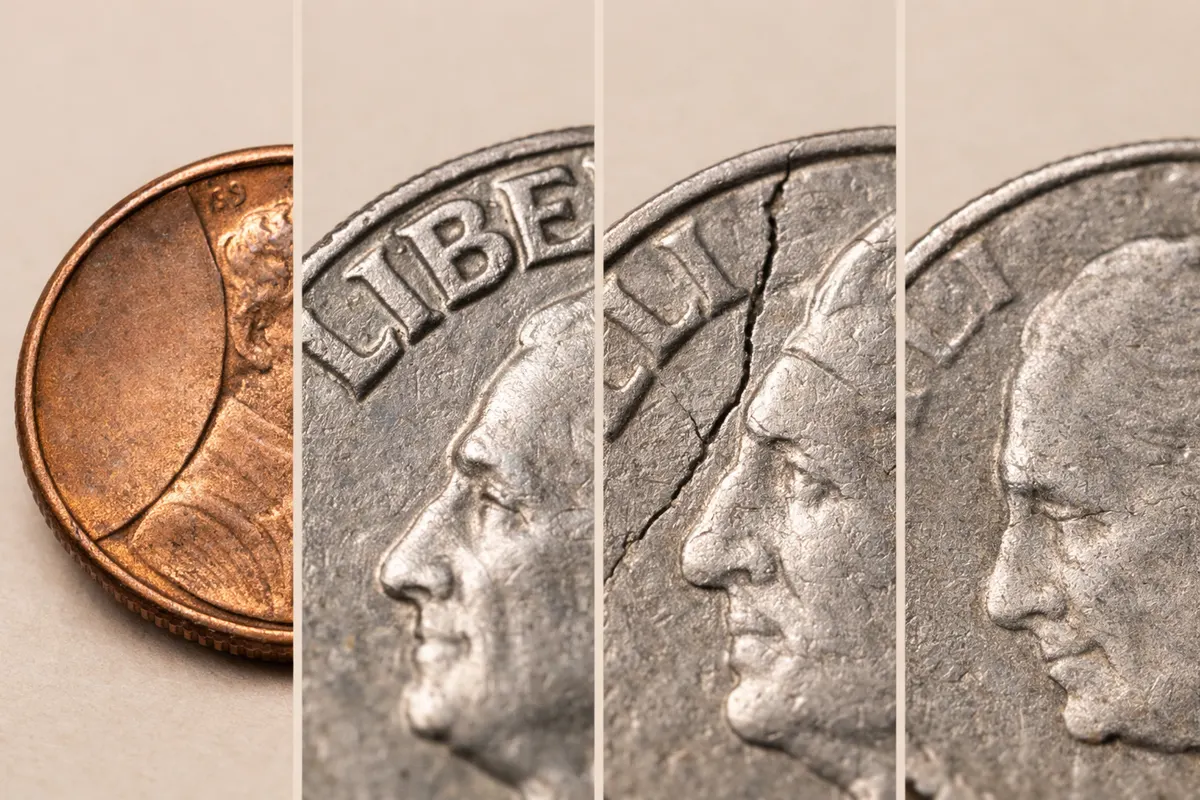
Quick answer: what photos can show about coin errors
Photos can reliably show several features that point to coin errors, but they rarely prove rarity or authenticity on their own. For off-center strikes, doubled dies, and die cracks you can use clear, well-lit close-ups of the date, lettering, rim, and the suspected error area to confirm the visual pattern. That evidence narrows possibilities and tells you whether a closer inspection or professional opinion is warranted.
An off-center strike generally shows a missing rim or design pushed to one side; doubled dies display repeated images or lettering with clear paired impressions; die cracks appear as raised, irregular lines on the coin surface. Each of these has distinct photo clues, but wear, post-mint damage, or cleaning marks can mimic them.
If a single phone photo shows a neat doubled letter with matching spacing and the doubling follows the die’s curves, that’s a stronger clue than a fuzzy dark image where highlights suggest doubling. Use photos to separate likely mint errors from damage, then gather multiple views before drawing any value or rarity conclusions.
- Photos reliably show shape, edge position, raised vs. incised marks, and repeated impressions—these are strong clues.
- Photos alone do not determine rarity, market value, or guaranteed authenticity—treat them as a first filter.
- Take close-ups of the date, mint mark, lettering, rim, and both obverse and reverse to build a complete photo record.
Strong photo clues for common coin errors
Focus first on clues that survive lighting and angle changes. For off-center strikes, the most dependable sign is asymmetry: design elements abruptly cut off at the rim or a visible gap where the die didn’t contact the planchet. A tilted camera can exaggerate this, so multiple angles that show the same missing detail increase confidence.
For doubled dies the strongest photographic evidence is repeat impressions that match the die’s contours—letters or devices where every stroke appears twice with consistent spacing and direction. Good examples show paired serifs, repeated hairlines on portraits, or doubled date numerals where the shadow and highlight follow the same doubled pattern.
Die cracks are raised, often branching lines that follow the die surface rather than the design. In photos you’ll notice raised ridges that cross devices and fields and sometimes produce subtle flow marks where metal pooled during striking. Because die cracks are part of the strike process they usually appear raised from the surface and cast tiny shadows at oblique light; that raised profile helps distinguish them from scratches or post-mint damage.
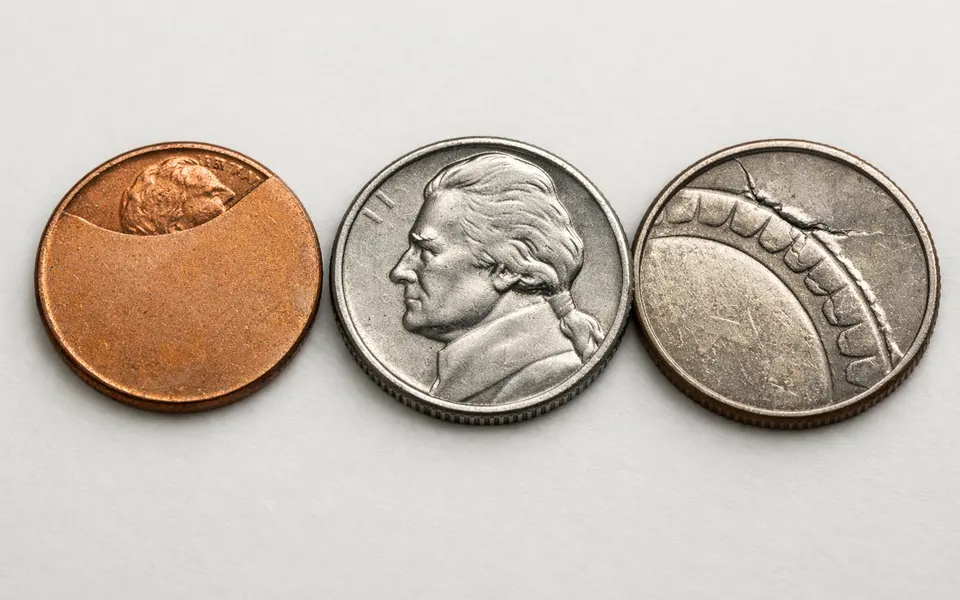
- Off-center strike: consistent truncation of design at the rim on the same side of both obverse and reverse.
- Doubled die: duplicated features with matching stroke direction and spacing across letters/devices.
- Die crack: raised, branching ridges that follow die topology and cast micro-shadows when lit obliquely.
- Raised vs incised: raised features on the face that interrupt lines of the design indicate minting anomalies; incised gouges usually signal later damage.
- Edge and rim clues: missing rim, partial reeded edges, or inconsistent rim height point strongly to strike issues rather than surface wear.
Weak signals
Not every oddity in a photo is a mint error. Surface scratches, corrosion, cleaning marks, or dirt in recessed areas commonly imitate doubling or cracking. For example, twin-looking shadows from raised dirt can mimic doubled die lines. Likewise, hairline scratches that run across a device can look like die cracks in low-resolution images.
Color and toning are weak indicators of a minting error. Patina, toning, or discoloration can help place a coin’s age but won’t confirm an off-center strike or doubled die. Avoid using color alone as a signal—lighting and camera white balance change perceived hues dramatically and are irrelevant to whether a strike error occurred.
Glare and reflections are frequent culprits. A shiny coin photographed with a single overhead flash may produce bright highlights that obscure small raised features or create false doubled edges. If you only have one angle or a single overexposed shot, treat claims about errors as tentative until you can get multiple, well-controlled photos.
- Color, tone, and luster: informative for condition but not proof of error.
- Single-angle photos: a single view often hides lateral offsets or exaggerates features—always get at least two angles.
- Reflections and shadows: bright spots can hide raised cracks or create false doubling.
- Post-mint damage: nicks, cleaning, and circulation wear can mislead even experienced collectors in photos.
Comparison workflow
A systematic comparison reduces guesswork. Start by photographing the coin with the frame: one straight-on shot of obverse and reverse, plus tight close-ups of the date, mint mark, suspected doubling, and any raised lines. Add a scale (ruler or coin-sized object) and note lighting direction. These images let you compare proportions, repetition, and relative position—critical when distinguishing doubled dies from mechanical damage.
Next, match multiple clues at once. For an alleged doubled die check that the doubling appears in the same direction across separate letters and that serifs, inner strokes, and terminals all show consistent paired impressions. For an off-center strike, confirm the truncation repeats logically around the coin (is the missing area consistent with a displaced die?) and compare both obverse and reverse if possible. Die cracks should thread across devices and fields in a way that follows the die’s surface rather than a straight-line impact pattern.
Use reference images and die variety guides for the specific coin series you’re examining. When the photographed doubling matches documented doubled-die examples for that year/mint and the spacing and location line up, your confidence increases. Conversely, if the blemish appears random, inconsistent, or isolated to a single high point, it’s more likely to be damage or post-strike alteration.
- Step 1 — Gather: full obverse/reverse, close-ups of date/mint mark, suspected error, and rim; include a scale.
- Step 2 — Compare location: does the anomaly sit where known die varieties show it, or is it in an unexpected place?
- Step 3 — Check pattern: doubled impressions should repeat across multiple letters/strokes with the same offset direction.
- Step 4 — Inspect profile: oblique lighting helps reveal raised die cracks versus surface scratches.
- Step 5 — Cross-check references: consult die variety photos or catalogs for that coin year/mint to corroborate.
Use Coinora to organize photos before deeper checks
Before leaning on market guides or specialist forums, save disciplined photo sets in Coinora: full obverse and reverse images, and separate close-ups of the date, mint mark, lettering, rim, and the suspected error area. Consistent file naming (year_mint_errorarea) and tags (off-center, doubled, die-crack) make later comparison and sharing easier. Storing multiple angles side-by-side reduces the chance of false positives when you revisit an image later.
Coinora helps you compare photos visually without claiming authentication. Use the app to keep the key close-ups adjacent, zoom fully on detail panels, and add short notes about lighting or suspected type (for example, “doubled die on date” or “raised crack crossing 3 o’clock”). That organized evidence will be useful if you later seek expert verification or list the coin for sale—experts prefer chronological, well-labelled images with context.
Remember the app is for documentation and first-pass filtering. After you assemble and tag your photo set in Coinora, follow up with higher-resolution images or a numismatic opinion if you believe the coin might be rare or valuable. Never infer market value or definitive authenticity from an app-organized photo set alone.
- Save at least six images: full obverse, full reverse, date close-up, mint mark close-up, suspected error, and rim/edge.
- Tag images by suspected issue (off-center, doubled die, die crack) and include lighting notes.
- Use side-by-side panels to compare suspected doubling across letters or devices.
- Keep a short provenance note: where the coin came from, any prior grading, and condition observations.
Related guides
Where to go next
When you are ready to identify a specific find, the photo-identification pages on this site walk through real cases — and Coin Identifier - Coinora can give you a first pass to compare against.
Take the next step →Frequently asked questions
Can I tell from a photo if a doubled die is valuable?
No. A clear photo can show doubled impressions and help identify the die variety, but value depends on rarity, market demand, and condition. Photos are a first step to identify a potential doubled die; authentication and market appraisal require a closer physical inspection or a specialist opinion.
How can I tell a die crack from a scratch in a picture?
Die cracks appear as raised, branching lines that follow the die’s surface and often cross devices and fields smoothly; they cast tiny shadows under oblique light. Scratches tend to be incised, inconsistent in depth, and may cut across fields without the raised profile or branching pattern. Multiple angled photos under raking light help distinguish the two.
Does an off-center strike always mean the coin is rare?
No. Off-center strikes vary in degree and frequency. Minor off-center strikes are common and usually have modest collector interest; extreme off-center pieces can be more sought after but must still be authenticated and graded to determine market value. Photos alone can indicate an off-center strike but not its market significance.
What photo settings produce the most useful images for error identification?
Use a macro-capable camera or phone with good daylight or diffused sidelight, disable harsh flash, and stabilize the coin against movement. Capture multiple angles, include a scale, and shoot in high resolution. Natural, oblique lighting reveals raised die features; avoid reflections and overexposure that hide fine details.