Coin Grading Scale
Coin Grading Scale — What to Look For, With Real Examples
Understand the coin grading scale and what a photo can show: visible grade clues, reasonable limits of a single image, and safe next checks to take.
A clear photo can narrow a coin grading scale estimate by revealing the most visible signals: overall wear, luster loss, hairlines or contact marks, and strike softness. Use a photo as the fastest first pass to separate heavily worn coins from those that might grade higher, but treat any image-based grade as an informed estimate, not a final certification.
In practical terms this category helps you identify whether a coin looks Good (G) vs Extremely Fine (XF) vs Mint State (MS) on the Sheldon-style scale by focusing on surface detail and reflective behavior. Photographs give strong evidence for wear patterns and high-contrast damage; they are weaker for sub-surface issues, exact metal composition, or professional grading qualifiers.
Before you rely on a single picture, take targeted images: a crisp obverse and reverse, a close-up of hairlines and the device fields, and an edge shot if possible. These views let a classifier or the Coin Identifier - Coinora app report an estimated grade range with the reasons behind it, so you know what to trust and what needs a hands-on check.
This page explains the visible clues to check, quick tests you can perform at home, what the app will return in a result, and the tasteful limits of photo-only grading.

How identification works
Step 1
Snap a photo
Take a clear, well-lit photo of your item in the Coin Identifier - Coinora app.
Step 2
Get an instant identification
The app reads the visible clues and returns the closest matches in seconds.
Step 3
Review the details
Compare the result with your photo, review any uncertainty, and check the suggested next steps.
Key visible signals used in the coin grading scale
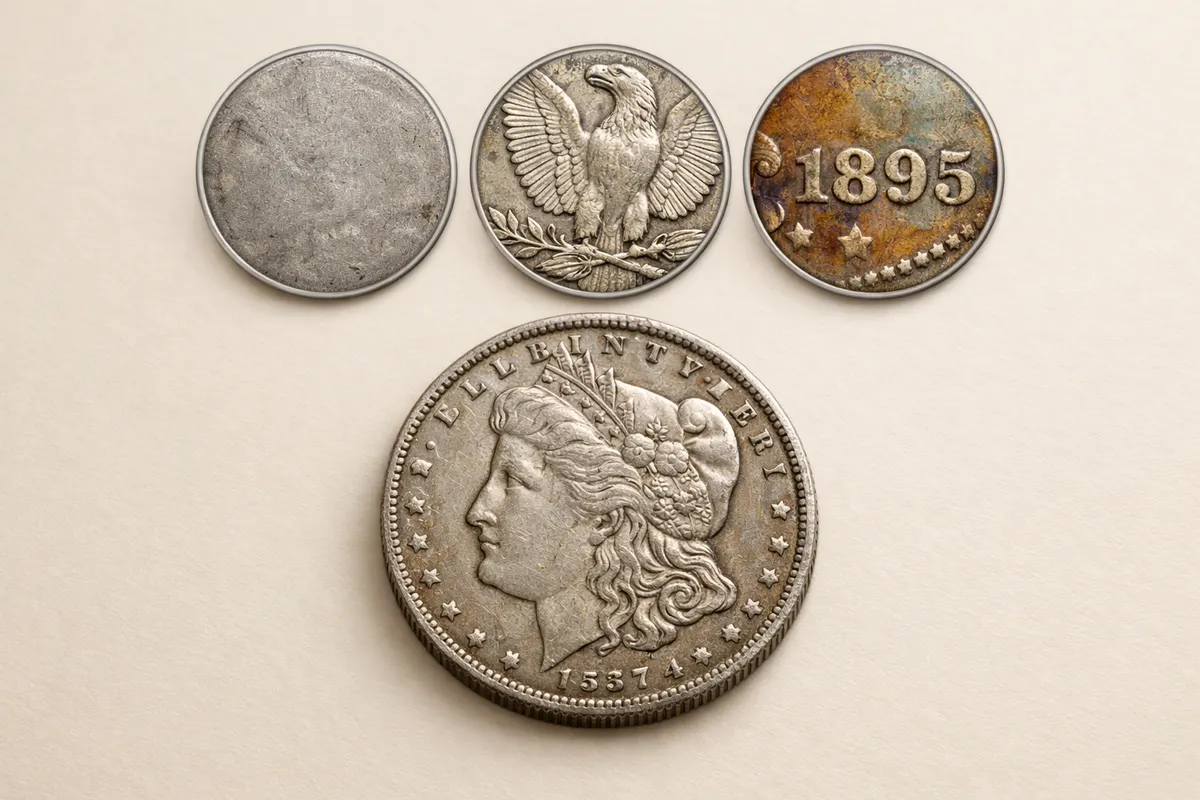
Look first at devices and high points for loss of detail. On circulating coins the highest points (cheek, hair, eagle breast) show the earliest wear; if letters and date are crisp the coin is likely in XF or higher, while flattened high points point toward VG or lower grades.
Observe luster and surface reflections. Mint State (MS) coins often show original luster and even, frosty or cartwheel reflections depending on strike and planchet. A matte or spotty field suggests circulation wear or environmental attack rather than mint-state preservation.
Note marks and hairlines separately from wear. Contact marks concentrated in the fields lower a grade more than a few tiny bag marks on the rim. Significant cleaning, abrasions, or polishing change the visual character and will be flagged as condition affecting grade.
- Strike: Compare the prominence of design elements—soft strikes look weaker even on uncirculated coins.
- High-point wear: flattened high points push a grade down more than tiny rim nicks.
- Finish clues: original luster vs satiny or matte fields helps separate MS from circulated grades.
- silver coin test: a non-magnetic needle test and careful weight check help confirm silver content before assuming high value.
- Surface marks vs wear: scratches that cross devices often result from cleaning or rough handling and lower a grade disproportionately.
What a coin grading scale identification result includes
A photo-based identification report focuses on visible, verifiable fields: an estimated grade range (example: VF20–XF40), a short rationale listing the key clues seen in photos, and condition notes such as visible hairlines, rim dings, or possible cleaning. The result deliberately frames the grade as an estimate and flags uncertainties that require hands-on inspection.
Reports typically include era and type identification (for context), likely metal or alloy from surface appearance, and a rarity/condition note when applicable. The app can point to historical examples and similar pictured results so you can compare your coin to documented grades and photos.
If you want deeper condition guidance, the report will also recommend specific next steps—professional slab grading for market certainty, a weight and dimension check for composition issues, or a targeted conservation consultation for valuable, cleaned, or corroded pieces.
For background reading on wear, luster, and strike as grading inputs, see Coin Grading Basics: Wear, Luster, Strike, and Condition Clues (https://coin-identifier.app/blog/coin-grading-basics) and for broader visual detection tips check Coin Detection: Visual Clues, Similar Lookalikes, and Safe Next Steps (https://coin-identifier.app/blog/coin-detection).
- Estimated grade range with short photographic evidence.
- Condition notes highlighting marks, cleaning signs, and luster.
- Context fields: type, era, likely metal, and comparable example photos.
- Actionable next checks: weight/edge checks, professional grading recommendation, and preservation advice.
Common coins and objects confused in grading photos
Worn commemoratives and business strikes can look similar in photos because both lose high-detail elements first; lighting and focus make a worn but high-relief commemorative appear better than a struck weak milli-issue. A clear date and mint mark close-up usually resolves these confusions.
Plated modern tokens or novelty pieces often mimic old silver coins in photos; edge detail and consistent weight measurements detect plating or core differences that mislead photo-only identification. A good edge shot or weight comparison catches many plated lookalikes before you assume a high grade.
Marine or soil-encrusted surfaces sometimes mask original luster and create the false impression of circulation wear. Cleaning to reveal details must be avoided until an expert advises, because aggressive cleaning reduces market grade and is often irreversible.
- Token vs coin: look for irregular edge patterns and non-standard legends.
- Plated vs solid metal: weight and a visible rim seam are tell-tale signs.
- Modern struck-with-wear vs genuinely circulated older coin: compare date and strike details with reference photos.
Frequently asked questions
What is an uncirculated coin and how can I tell if mine qualifies?
An uncirculated coin generally shows no wear on high points and retains original luster and mint finish. From a photo you can look for fully sharp devices, unworn rims, and consistent reflective behavior across fields. Note that some mint-state coins still show contact marks from handling; a photo-based result will describe those marks and recommend in-person verification for market-sensitive pieces.
Is my coin worth anything if it looks worn and I only have one photo?
A single photo can indicate whether a coin has collectible condition or is heavily worn, but it cannot guarantee market value. If visible details like date and mint mark are readable and the coin shows rarity markers, it may have value despite wear. The app gives an estimated grade range and suggests next checks—weight, dimensions, and comparative auction results—before you rely on any price estimate.
How to spot fake coins when the design looks sharp but something feels off?
Look for inconsistent edge work, incorrect lettering, wrong weight, or unexpected magnetism; these are common signs of counterfeits. A sharp design alone doesn't rule out a fake—materials and fine details matter. A photo report will flag suspicious inconsistencies and recommend hands-on alloy tests or scale checks for confirmation.
How accurate is a silver coin test from a photo when assessing composition?
A true silver coin test requires hands-on checks—weight, specific gravity, or acid/magnet tests—so a photo can only suggest silver by color and tarnish patterns. The report will note visual indicators of silver but will mark composition as unconfirmed and recommend a physical silver coin test or professional assay if composition affects value or grading decisions.
Related guides
Get a photo-based grade estimate with Coin Identifier - Coinora
After you review these visible clues, use the Coin Identifier - Coinora iOS app to capture clear photos and receive an evidence-backed grade estimate and condition notes. The app frames results as photo-based estimates and suggests hands-on next steps when needed. Start the grade check at https://coin-identifier.app/tools/coin-grade-estimator and follow the recommended weight and edge checks for any coins flagged as high-condition or potentially valuable.